

Position:
Home
 News
company news
Introduction to hexagonal flange nuts
Introduction to hexagonal flange nuts
Release time:2017-12-25 Reading volume: 506
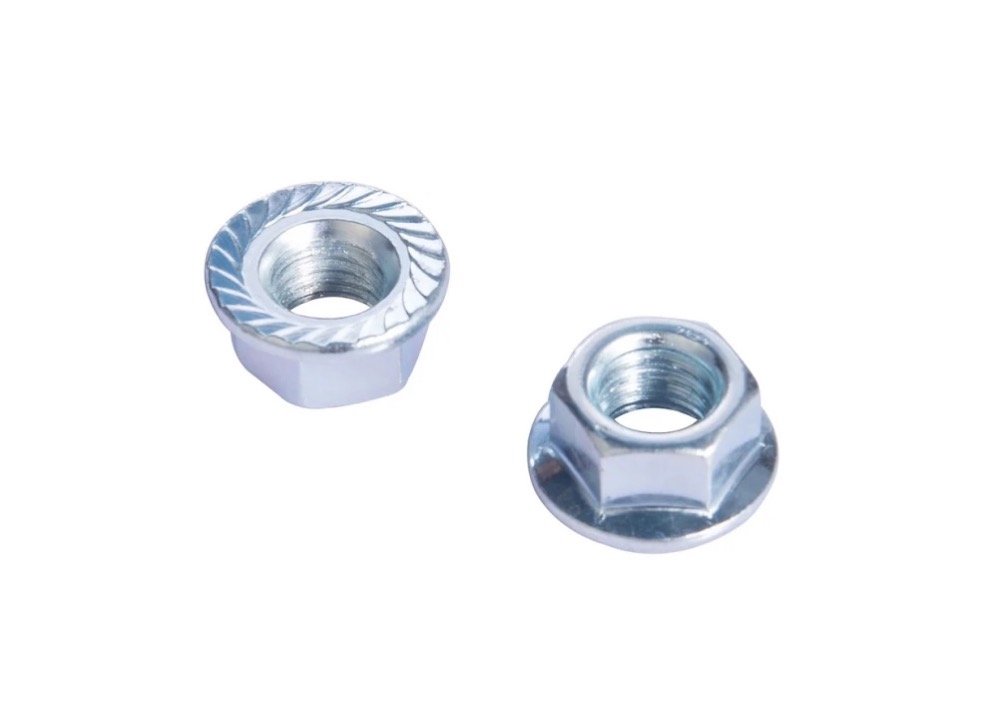
Hexagonal flange nuts are fasteners with specific designs and functions. The following is a detailed introduction to them:
Definition and alias
Definition: Hexagonal flange nut, also known as washer nut, serrated nut, hexagonal flange nut or flange nut, etc. It has a wide flange at one end and is used as an integral gasket.
English name: Orange nut (or Hexagon nuts with flange)
main features
Structure:
Nut body: The main body is hexagonal in shape.
Flange face: As an integral washer at one end of the nut body, it helps to disperse pressure and reduce the possibility of component damage.
Cap (some models): Provides additional sealing and protection at the other end of the nut body.
Serrated flange (some models): Provides locking effect to prevent nuts from loosening due to vibration.
Materials: Common materials include A3 low-carbon steel, 35K high-speed steel wire, 45 # steel, 40CR, 35Crmoa, etc.
Hardness levels: including 4, 5, 6, 8, 10, and 12 levels.
Surface treatment: Generally, it is coated with colored zinc or white zinc, and treated with cold electro galvanizing.
Specifications: The main specifications include M5, M6, M8, M10, M12, M16, M20, etc. (specifications above M20 and flange nuts of M14 and M18 are not commonly used).
Thread specification: Refer to the national standard nut thread.
National standard code: GB6177-2000.
Usage characteristics
Sealing performance: Due to the design of the cap, the hexagonal flange nut has good sealing performance, which can effectively prevent harmful substances such as rainwater, moisture, and dust from infiltrating the nut body, and prevent rusting of the nut body.
Corrosion resistance: Galvanizing treatment enhances its corrosion resistance, which can greatly extend its service life.
Application: Mostly used in pipeline connections or workpieces that require the addition of nut contact surfaces, especially suitable for situations where two surfaces need to be connected under low resistance and sealing conditions, such as pipelines, valves, and cylinders.
Materials and application scenarios
Stainless steel: suitable for applications that require corrosion resistance and high temperature resistance, such as chemical equipment and high-temperature equipment.
Carbon steel: It has good strength and stiffness performance, and is suitable for applications that can withstand large loads.
Brass: has good conductivity and thermal conductivity, suitable for scenarios that require the transmission of electrical signals or heat.
Aluminum alloy: characterized by lightweight and good corrosion resistance, suitable for occasions that require lightweight and exquisite appearance.
summary
Hexagonal flange nuts are powerful fasteners with unique designs and diverse material choices, making them widely used in various fields. When selecting and using, it is necessary to choose appropriate materials and specifications based on actual needs and environmental conditions.